
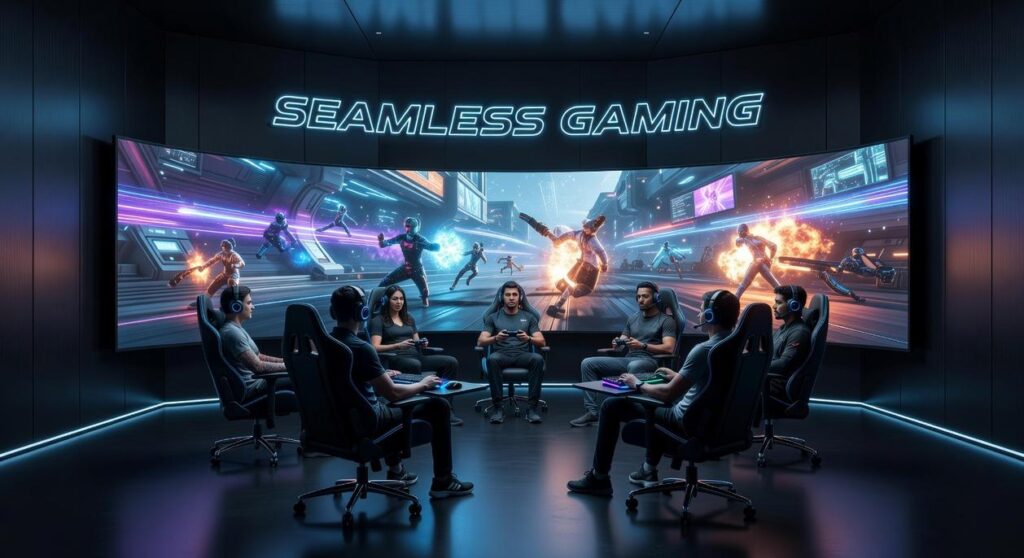
The gaming world never stands still—and gaming trends 2026 are set to redefine how you play, compete, and win. With rapid advances in AI-driven mechanics, immersive hardware, cross-platform ecosystems, and evolving monetization models, the industry is entering a new era. The challenge? Separating real, game-changing innovation from overhyped distractions. This strategic breakdown cuts through the noise to spotlight the technological shifts, gameplay evolutions, and business changes that will directly impact your performance and competitive edge. Backed by years of analyzing multiplayer tactics and performance data, this forecast delivers a clear, actionable look at what truly awaits gamers in 2026.
Generative AI: The Dawn of Truly Dynamic Worlds
Generative AI is often described as “smarter NPCs,” but that barely scratches the surface. An NPC (non-playable character) is any in-game character not controlled by a player. Traditionally, NPCs follow scripted paths and repeat the same dialogue (we’ve all heard that guard say the same line 400 times). Generative AI changes this by creating unscripted realities—characters that react based on context, memory, and player behavior.
Instead of cycling through pre-written responses, AI-driven NPCs generate unique dialogue in real time. If you betray a faction early on, its members might distrust you hours later—even altering prices, quest access, or combat behavior. This creates emergent gameplay, meaning unexpected outcomes formed by player choice rather than fixed scripts. The result? Single-player and co-op campaigns that feel infinitely replayable.
Procedural Content Generation (PCG) 2.0 takes this further. PCG originally meant randomized maps—think shuffled dungeons with familiar layouts. Now, AI can craft adaptive quests and evolving storylines. Imagine accepting a rescue mission. If you previously sided with smugglers, the “victim” could turn out to be bait in a counter-ambush. The quest dynamically shifts, not because developers pre-wrote every branch, but because AI assembles it logically in real time.
Some argue this risks losing narrative control. That’s fair. But with guardrails and design constraints, developers guide tone while AI fills in detail—like a dungeon master improvising within rules.
Competitive play evolves too. AI-driven training bots analyze your tactics, adapt mid-match, and exploit your habits. In esports, this creates a new preparation tier—practice partners that never plateau. As gaming trends 2026 accelerate, adaptive AI may become the standard training ground for serious competitors.
Seamless Play: The Maturation of Cloud and Cross-Platform

Cloud gaming has quietly crossed a threshold. A few years ago, the conversation revolved around latency—input lag, compression artifacts, and whether competitive players could tolerate the delay. In 2026, that debate feels dated. With edge servers (localized data centers that reduce distance between player and server) and stronger broadband infrastructure, cloud platforms now offer near-instant access to massive libraries on almost any device. In simple terms, you click, and you’re in—no 80GB downloads, no hardware upgrades (your aging laptop breathes a sigh of relief).
Some critics argue that native hardware will always outperform the cloud. That’s true at the extreme competitive tier. However, for a huge segment of players, the convenience outweighs the marginal performance gap. When friction disappears, playtime increases. That’s not hype—that’s usage data reported by major platform holders like Microsoft and NVIDIA in recent earnings briefings.
At the same time, cross-play has evolved into true cross-progression. Instead of merely matching players across platforms, unified accounts now sync cosmetics, ranks, and achievements everywhere. Cross-progression means your progress lives in the cloud, not on a single console. Start a match on PC, finish it on mobile during your commute—everything carries over seamlessly.
As highlighted in gaming trends 2026, this unified ecosystem expands player pools dramatically. More players mean wider skill variance and diverse playstyles in every lobby. The tactical impact is significant: strategies must be flexible, not scripted. You can’t rely on predictable metas when your opponents range from casual mobile newcomers to seasoned PC veterans.
For deeper breakdowns of evolving multiplayer ecosystems, explore https://eve2876.com for updated arena insights and strategy guides.
The New Economy: How We’ll Pay and Play
The way we fund our favorite digital worlds is shifting fast—and not just in Silicon Valley boardrooms or Seoul esports arenas. From indie dev hubs in Austin to AAA studios in Tokyo, monetization is becoming more transparent, community-driven, and skill-focused.
Beyond the Battle Pass
Battle passes aren’t disappearing, but they’re no longer the final boss of revenue models. Player-to-player marketplaces—platforms where users buy and sell user-generated content (UGC), meaning skins, maps, mods, or cosmetic assets created by other players—are emerging as primary revenue drivers. Think Roblox’s creator economy or Unreal Editor integrations inside Fortnite (yes, that big). Developers take a percentage, creators earn real income, and players get fresh content weekly (everybody wins, mostly).
Some critics argue this fragments quality control. Fair. But curated storefronts and rating systems increasingly mirror Steam Workshop standards, reducing clutter while rewarding top creators.
Subscription Evolution
Services like Game Pass are likely to evolve into tiered ecosystems:
- Early beta access and closed test servers
- Exclusive in-game cosmetics or seasonal drops
- Cloud-based AI coaching tools for ranked modes
In competitive hubs like Los Angeles’ esports training facilities, AI-driven performance breakdowns are already common. Packaging that into subscriptions feels inevitable—especially as gaming trends 2026 point toward performance optimization.
For weekly culture shifts, check out top 5 viral game moments everyone is talking about this week.
The Decline of the Loot Box
Randomized, chance-based monetization—aka loot boxes—is steadily fading due to regulatory scrutiny in the EU and parts of Asia (see Belgium’s 2018 ban). While some argue randomness adds excitement, players increasingly prefer direct purchase clarity. When value is transparent, trust follows—and in today’s economy, trust converts.
Hardware’s Next Leap: The Tech Behind the Scenes
I still remember booting up a flagship title on an aging GPU and watching my frame rate collapse the moment real-time ray tracing kicked in. That stutter was my wake-up call: hardware isn’t just background tech—it defines the experience.
The CPU/GPU arms race in 2026 is pushing toward real-time path tracing as a baseline, not a luxury. Path tracing (a rendering technique that simulates how light actually behaves) delivers near-cinematic realism. Next-gen GPUs are expected to double down on parallel cores and smarter cache systems, while CPUs add more efficiency cores to juggle AI, physics, and background systems simultaneously. Some argue visuals have plateaued. After testing early path-traced demos, I disagree (the leap is obvious the second light hits reflective armor).
Then there are NPUs (Neural Processing Units)—dedicated AI accelerators built to run machine learning tasks locally. Instead of offloading AI to the cloud, your system handles smarter NPC behavior and adaptive environments without tanking performance. This shift is central to gaming trends 2026.
Performance tip:
- Master AI upscaling and frame generation settings early; they’ll be essential for staying competitive in high-refresh multiplayer arenas.
Hardware isn’t just evolving. It’s rewriting what’s possible on screen.
Your Next Move in the Game of Tomorrow
You came here to understand where the industry is heading, and now you have a clear view of gaming trends 2026—from AI-driven worlds to seamless cross-platform ecosystems and performance-focused hardware. The challenge isn’t access to information; it’s staying ahead before these shifts become standard. If you wait, you fall behind.
The next step is simple: start adapting now. Upgrade your setup, refine your strategies, and rethink how you compete in evolving digital arenas. Don’t just react to the future of gaming—prepare for it, master it, and position yourself to dominate every match that comes next.
 Content Strategist
Adamenicos Moller has opinions about 2876 multiplayer arena tactics. Informed ones, backed by real experience — but opinions nonetheless, and they doesn't try to disguise them as neutral observation. They thinks a lot of what gets written about 2876 Multiplayer Arena Tactics, Competitive Strategy Breakdowns, Digital Realms and Gameplay Basics is either too cautious to be useful or too confident to be credible, and they's work tends to sit deliberately in the space between those two failure modes.
Reading Adamenicos's pieces, you get the sense of someone who has thought about this stuff seriously and arrived at actual conclusions — not just collected a range of perspectives and declined to pick one. That can be uncomfortable when they lands on something you disagree with. It's also why the writing is worth engaging with. Adamenicos isn't interested in telling people what they want to hear. They is interested in telling them what they actually thinks, with enough reasoning behind it that you can push back if you want to. That kind of intellectual honesty is rarer than it should be.
What Adamenicos is best at is the moment when a familiar topic reveals something unexpected — when the conventional wisdom turns out to be slightly off, or when a small shift in framing changes everything. They finds those moments consistently, which is why they's work tends to generate real discussion rather than just passive agreement.
Content Strategist
Adamenicos Moller has opinions about 2876 multiplayer arena tactics. Informed ones, backed by real experience — but opinions nonetheless, and they doesn't try to disguise them as neutral observation. They thinks a lot of what gets written about 2876 Multiplayer Arena Tactics, Competitive Strategy Breakdowns, Digital Realms and Gameplay Basics is either too cautious to be useful or too confident to be credible, and they's work tends to sit deliberately in the space between those two failure modes.
Reading Adamenicos's pieces, you get the sense of someone who has thought about this stuff seriously and arrived at actual conclusions — not just collected a range of perspectives and declined to pick one. That can be uncomfortable when they lands on something you disagree with. It's also why the writing is worth engaging with. Adamenicos isn't interested in telling people what they want to hear. They is interested in telling them what they actually thinks, with enough reasoning behind it that you can push back if you want to. That kind of intellectual honesty is rarer than it should be.
What Adamenicos is best at is the moment when a familiar topic reveals something unexpected — when the conventional wisdom turns out to be slightly off, or when a small shift in framing changes everything. They finds those moments consistently, which is why they's work tends to generate real discussion rather than just passive agreement.